The ProCredit Bank Net Zero initiative, aligned with the goals of the Paris Agreement, is designed for small and medium-sized enterprises that want to improve their operations and strengthen their resilience to climate and economic challenges.
Key steps and tools to support you on the path to Net Zero:
• Net Zero Operations Step-by-step guide
• CO₂ emission measurement calculator
• Emission reduction recommendations
• Environmental and financial savings
• Regulatory compliance
Your guide through Net Zero transition
Measure the impact, recognize the opportunities – sustainable operations that mean savings to small and medium-sized enterprises.
Measure the impact, recognize the opportunities – sustainable operations that mean savings to small and medium-sized enterprises.
Improve your operations by reducing CO2 emissions

What does your business gain from the Net Zero initiative?



Introducing innovation and resilience
Developing new products and services aligned with green trends.

Download the Net Zero guide and learn about the possibilities
The Net Zero guide helps you identify key areas for reducing emissions and optimizing costs. You will learn how to improve energy efficiency, switch to renewable energy sources, and modernize your business processes.
Measure your emissions using the ProCredit CO2 calculator
The ProCredit CO2 calculator calculator enables small and medium-sized enterprises to easily measure the greenhouse gas emissions generated by their activities. It provides a clear foundation for informed decision-making and for planning the next steps in your emission reduction journey.
Set goals
Measurable and time-bound goals make it easier to track progress and ensure long-term sustainability. By setting targets that are both realistic and ambitious, you demonstrate a strategic commitment to reducing emissions.
Implement steps tailored to the industry you work in.
ProCredit Bank provides expert and financial support in the implementation of sustainable solutions, tailored to the needs of your company. After setting goals, their realization follows through practical measures — from investments in energy-efficient technologies to the transition to renewable sources.
Continuously monitor your transformation through reporting
Consistent monitoring of results and regular reporting on achievements form the foundation of long-term sustainability and credibility. This approach not only strengthens the trust of customers and partners but also fosters a culture of accountability within your organization. Transparent reporting enables acurate evaluation of implemented measures and supports ongoing strategic improvement.
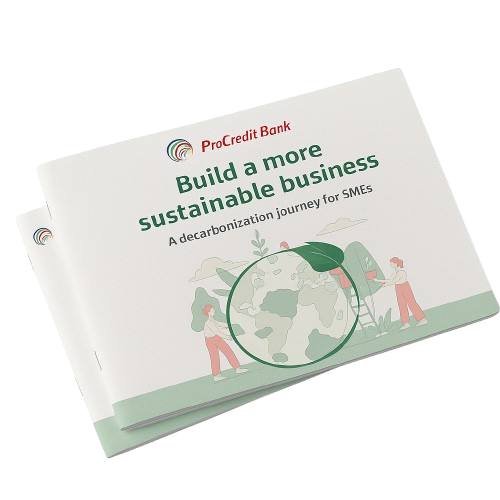
Download the Net Zero guide and calculate your emissions
Introducing sustainable practices starts with understanding what we measure, why it matters, and how we can improve.
We have prepared a practical guide through the Net Zero transition, which will help you:
- focus on the key aspects of the Net Zero transition,
- gain deeper insight into essential concepts,
- identify specific steps you can take.
Before using the ProCredit CO2 calculator, we advise you to read the guide to:
- know what data you need to collect, and
- cover all areas of the operation being analyzed.
Measuring emissions is more than a number – it is the first step toward the sustainable transformation of your operations.
Calculate your emissions with the ProCredit CO2 calculator
Read moreWhy should you consider a Net Zero approach?
By introducing specific measures to reduce energy consumption – such as switching to LED lighting, modernizing outdated equipment, or investing in renewable energy sources – small and medium-sized enterprises can significantly reduce their operating costs.
These investments often pay for themselves in a short period, while in the long term they provide a more stable financial position and reduced dependence on an increasingly volatile energy market.
Energy efficiency is not only an environmental responsibility but also an economically smart move that increases operational resilience and allows companies to plan more confidently for future growth.
The legislative framework for environmental protection is becoming increasingly stringent—both in North Macedonia and internationally. By adopting emission reduction strategies in a timely manner, small and medium-sized enterprises can remain compliant with regulations, avoid potential fines, and position themselves as responsible market participants.
It is particularly important to note that the European Union is introducing a Carbon Border Adjustment Mechanism (CBAM), which aims to establish a fair price for CO₂ emissions from imported goods with a high carbon footprint. This regulation, expected to be fully implemented by 2027, will directly affect companies exporting goods to the European Union. Businesses that are already measuring their emissions and taking steps to reduce them will be ready to respond to these requirements without disruption to their operations or additional financial burdens.
The transition to a Net Zero operating model involves not only reducing emissions but also creating space for innovations that improve overall performance. Introducing sustainable practices often encourages a rethinking of existing processes, products, and services, opening the door to new technologies, materials, and approaches. Such a transformation can lead to the development of products with a lower environmental impact, more efficient processes, and better resource utilization—while also unlocking entirely new revenue streams.
In addition to strengthening your competitive position, this approach increases resilience to external risks—from fluctuations in energy and raw material prices to regulatory changes and evolving consumer expectations. Companies that proactively adapt to new operating conditions respond faster to challenges and emerge stronger from uncertainty. Net Zero is not only an environmental goal but also a business strategy for long-term stability and growth.
At a time when consumers, investors, and business partners increasingly value sustainability, a commitment to Net Zero is becoming a powerful tool for market differentiation. Companies that actively work to reduce their carbon footprint not only contribute to environmental protection but also build a stronger, more credible brand.
This approach attracts environmentally conscious consumers, as well as large buyers and partners who increasingly require sustainability as a condition for collaboration. Transparent communication of progress and goals further strengthens trust, increases customer loyalty, and opens doors to new markets. In this way, sustainable operations become not only an ethical choice but also a strategic advantage that drives sales growth and strengthens long-term competitiveness.